
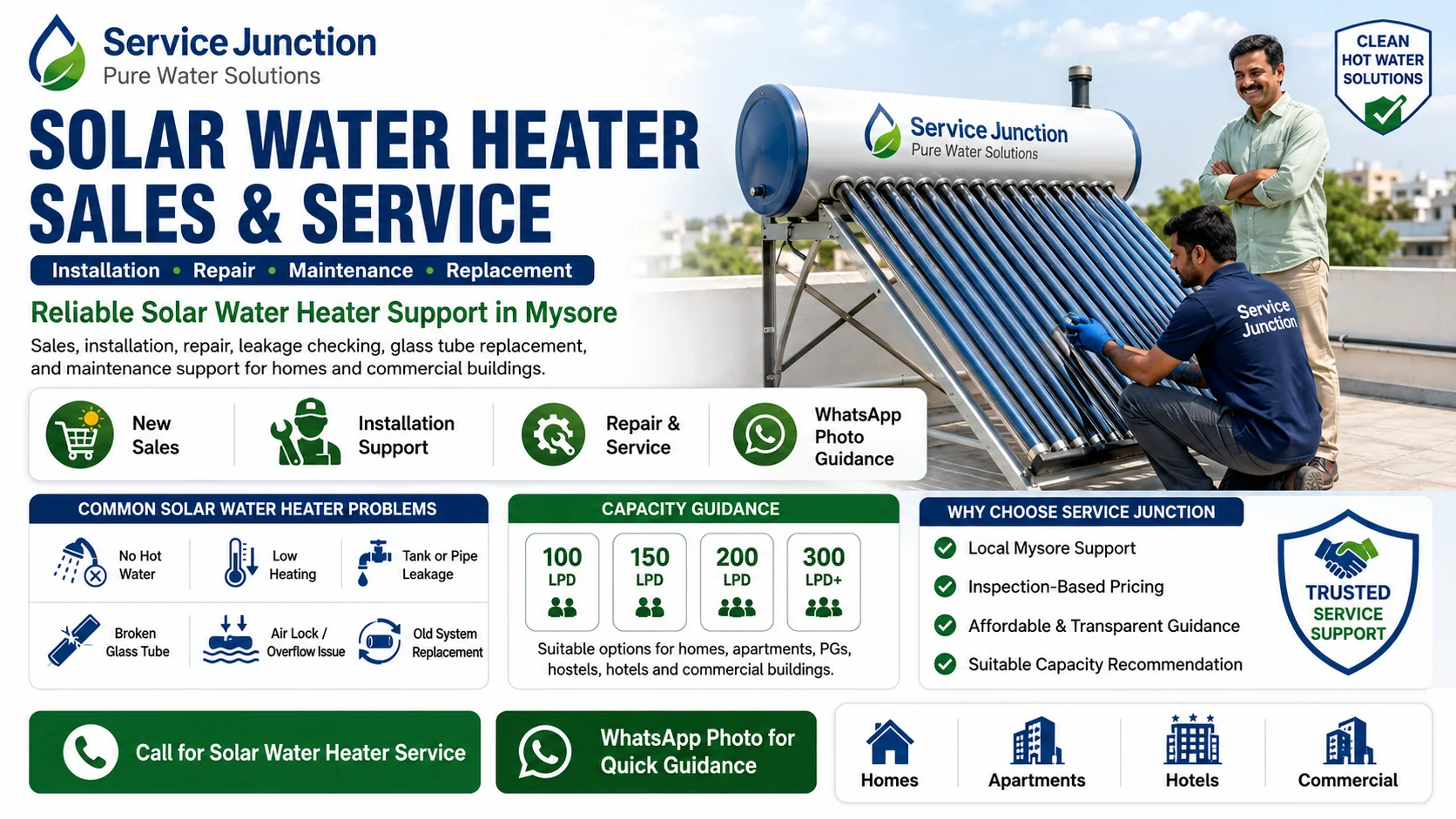
Solar Water Heater Tank Replacement
Solar water heater tank replacement may be needed when the storage tank is leaking, rusted, damaged, not holding hot water properly, or no longer suitable for the current hot-water requirement.
Service Junction helps with solar water heater tank replacement enquiry, tank leakage checking, capacity guidance, inlet and outlet fitting check, anode condition review, pipe connection support, old tank removal guidance and new tank installation support based on site condition.
When Tank Replacement Is Needed
A solar water heater tank should be checked when the problem is coming from the storage tank instead of only the tube, pipe or valve.
Tank replacement may be required when:
- Water is leaking from the tank body
- Tank has rust or corrosion signs
- Hot water does not stay warm for long
- Tank insulation is weak or damaged
- Tank capacity is too small for current use
- Inlet or outlet fitting area is damaged
- Repeated leakage happens near tank joints
- Tank has internal scaling or heavy deposits
- Pressure-related damage is suspected
- Old tank repair cost is too high
Minor fitting leakage may be repairable, but tank body leakage often needs replacement guidance.
Tank Leakage Check
Tank leakage should be checked carefully before deciding replacement.
The technician should identify whether water is leaking from:
- Tank body
- Hot water outlet
- Cold water inlet
- Glass tube connection area
- Flange area
- Pressure relief valve
- Drain connection
- Overflow line
- Pipe joint near tank
- Old plumbing fitting
If the leak is from a pipe joint or valve, replacement of the full tank may not be required. If the tank body is leaking due to corrosion or damage, replacement may be the practical option.
Tank Capacity Selection
Solar water heater tanks are selected based on LPD capacity.
Common capacity options include:
- 100 LPD for small family use
- 150 LPD for medium domestic use
- 200 LPD for higher daily use
- 300 LPD for larger homes or shared usage
- 500 LPD and above for heavy hot-water requirement
If the old tank capacity was too small, the new tank should be selected after checking number of users, bathrooms, hot-water usage timing and plumbing distance.
ETC and FPC Tank Compatibility
Tank replacement should match the solar water heater system type.
ETC systems need a compatible tank for evacuated glass tube fitting, tube hole size, rubber seals and tank position.
FPC systems need a tank that matches the collector connection, pressure condition, inlet-outlet size and circulation requirement.
Wrong tank selection can cause leakage, poor heating, fitting mismatch or repeated service issues.
Anode and Corrosion Check
Many solar water heater tanks use an anode for corrosion protection.
During tank inspection, the technician may check:
- Anode condition
- Rust signs
- Water quality impact
- Scaling inside tank
- Flange area condition
- Tank inner surface condition
- Fitting damage
- Whether replacement is better than cleaning
If corrosion has badly affected the tank, replacement may be safer than repeated repair.
Tank Insulation Problem
The storage tank should hold hot water for usable duration.
If hot water becomes cold quickly, possible reasons include:
- Damaged tank insulation
- Old tank body condition
- Poor pipe insulation
- Wrong usage timing
- Cold water mixing
- Long plumbing distance
- Tank capacity lower than requirement
Tank insulation should be checked before assuming the full system has failed.
Inlet, Outlet and Valve Fitting Check
Tank replacement should include checking all connection points.
Important fittings include:
- Cold water inlet
- Hot water outlet
- Pressure relief valve
- Air vent
- Overflow line
- Drain pipe
- Pipe unions
- Rubber seals
- Flange area
- Electrical backup opening, if available
Loose or damaged fittings can create leakage even after installing a new tank.
Old Tank Removal
Old tank removal should be planned safely because the tank may be heavy, roof-installed and connected to water lines.
Before removal, the technician should check:
- Roof access
- Tank water draining
- Stand condition
- Pipe connection condition
- Glass tube or collector connection
- Electrical backup connection, if present
- Safe lifting requirement
- Old plumbing condition
Electrical backup parts should be handled only by a qualified person.
New Tank Installation Check
After replacing the tank, the system should be checked before regular use.
Basic checks include:
- Tank level
- Stand stability
- Tube or collector connection
- Hot water outlet
- Cold water inlet
- Valve position
- Air vent
- Overflow line
- Pipe leakage
- Tank filling
- Hot-water flow
- Electrical backup safety, if connected
A leak check should be done after filling the tank.
Tank Replacement Cost Factors
Solar water heater tank replacement cost depends on:
- Tank capacity
- ETC or FPC system type
- Tank material
- Tank insulation
- Inlet and outlet fitting requirement
- Rubber seal requirement
- Valve and pipe condition
- Roof access
- Old tank removal work
- Plumbing correction
- Stand condition
- Electrical backup connection, if present
Final cost should be confirmed only after checking the system and site condition.
Repair or Replace the Tank?
Tank repair may be suitable when leakage is from a pipe joint, valve, seal, fitting or flange area.
Tank replacement may be better when:
- Tank body is leaking
- Tank is rusted
- Insulation is badly damaged
- Capacity is too small
- Multiple fittings are weak
- Tank has heavy scaling
- Repeated leakage has happened
- Repair cost is close to replacement cost
A site check helps decide whether tank repair or replacement is practical.
What to Share Before Booking
Before requesting solar water heater tank replacement support, share:
- System photo
- Tank leakage photo
- Capacity, if known
- Brand name, if visible
- ETC or FPC type, if known
- Roof access photo
- Current hot-water issue
- Whether tank body is leaking
- Whether leakage is from pipe or fitting
- Approximate system age
- Whether electrical backup is connected
These details help guide the correct tank, fitting, service and replacement requirement.
Call or WhatsApp for Solar Water Heater Tank Replacement
Need solar water heater tank replacement?
Call or WhatsApp Service Junction and share your system photo, tank leakage photo, capacity and issue. Our team will guide the next step for tank inspection, replacement, pipe correction, valve checking or old system replacement support.
FAQs
When should a solar water heater tank be replaced?
Tank replacement may be needed when the tank body leaks, rust is visible, insulation is weak, capacity is too small, or repeated leakage happens near the tank.
Can tank leakage be repaired?
Fitting or pipe leakage near the tank may be repairable. If the tank body itself is leaking due to corrosion or damage, replacement may be better.
How do I choose the correct tank capacity?
Capacity depends on number of users, bathrooms, daily hot-water requirement and usage timing. Common options include 100 LPD, 150 LPD, 200 LPD, 300 LPD and 500 LPD.
Can I replace only the tank and keep the old tubes?
It may be possible if the old tubes, seals, stand and system type are compatible with the new tank. The technician should check before confirming.
What if my tank does not keep water hot?
The issue may be tank insulation, pipe insulation, cold-water mixing, wrong capacity, long plumbing distance or old tank condition.
Is ETC tank different from FPC tank?
Yes. ETC and FPC systems use different connection and collector arrangements. Tank compatibility should be checked before replacement.
Should the stand be checked during tank replacement?
Yes. The stand should be checked because a weak or rusted stand may not safely support the replacement tank.
What details should I share before booking?
Share the system photo, leakage photo, capacity, brand name if visible, roof access photo, system age and whether electrical backup is connected.